
Blog
Real-Time GPS Tracking UK: Benefits for Vehicle Owners

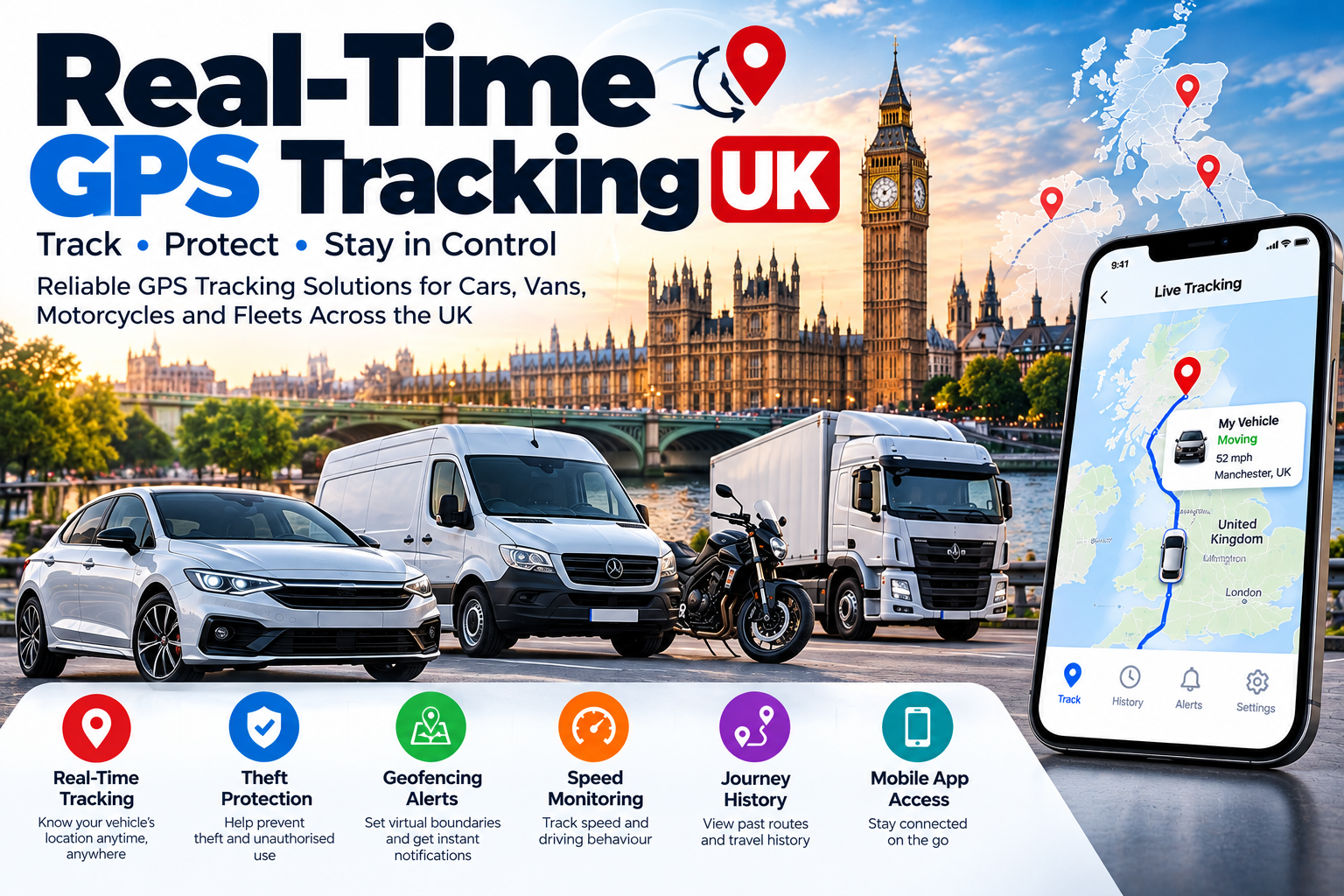
Real-Time GPS Tracking UK: 7 Powerful Benefits for Vehicle Owners
Keeping track of your vehicle is becoming increasingly important for private motorists and businesses across the UK. Whether you own a valuable car, manage a fleet of commercial vehicles or simply want greater visibility over vehicle movements, tracking technology can provide useful information when you need it.
Real-Time GPS Tracking UK offers a practical way to monitor vehicle locations, review journeys and support vehicle recovery if theft occurs. Depending on the tracking system, users may also benefit from movement alerts, journey reports and access through a mobile application or online dashboard.
From individual car owners to fleet managers, understanding how real-time GPS tracking works can help you choose a system that matches your security and monitoring requirements.
In this guide, we explore seven key benefits of real-time GPS tracking, how the technology works, what to consider before buying and how to select a suitable tracking solution in the UK.
What Is Real-Time GPS Tracking UK?
Real-Time GPS Tracking UK refers to vehicle tracking systems that use satellite positioning and communication technology to provide regularly updated location information.
A GPS tracking device determines its position using signals from navigation satellites. Depending on its design, the device then transmits location information through a mobile network or another communication method to a tracking platform.
The owner or authorised user can access this information through a compatible application, website or monitoring service.
Depending on the system, features may include:
- Live or frequently updated vehicle location.
- Journey history.
- Movement notifications.
- Geographical zone alerts.
- Vehicle-use reports.
- Fleet monitoring.
- Theft-related notifications.
- Support for vehicle recovery.
Not every tracker offers all these functions. Update frequency, network coverage, monitoring arrangements and subscription features vary between products.
The term real-time also does not necessarily mean that the vehicle’s location updates continuously without any delay. The frequency of updates depends on the device, communication network and service package.
How Does Real-Time GPS Tracking Work?
Understanding the technology makes it easier to see how Real-Time GPS Tracking UK can benefit vehicle owners.
Step 1: The Tracking Device Determines Location
The GPS receiver uses satellite signals to calculate the vehicle’s position.
This information can include geographical coordinates and, depending on the system, details such as speed or direction.
Step 2: The Device Transmits Location Information
The tracker sends its data to a connected tracking platform using its supported communication technology.
Many vehicle trackers use mobile networks, although the available communication method depends on the product.
Step 3: The Tracking Platform Displays the Vehicle
The tracking platform processes the incoming information and presents it through an application or online dashboard.
Authorised users can then view the vehicle’s reported location and, where supported, access previous journeys.
Step 4: Alerts and Reports Provide Additional Information
Depending on the system, users may receive notifications about certain events, such as unexpected movement or entry into or exit from a defined geographical area.
These features can be useful for both personal vehicle security and business fleet management.
7 Powerful Benefits of Real-Time GPS Tracking UK
1. Monitor Your Vehicle’s Location
One of the main advantages of Real-Time GPS Tracking UK is being able to view your vehicle’s reported location remotely.
Instead of relying on memory or manually checking where a vehicle has been parked, an authorised user can access location information through the tracking platform.
This can be useful when:
- You have parked in an unfamiliar location.
- A family vehicle is shared between authorised drivers.
- A company vehicle is being used for business.
- You need to review a vehicle’s recent movements.
- You want additional visibility over a valuable vehicle.
The usefulness of this feature depends on location-update frequency, communication coverage and the capabilities of the tracking service.
2. Support Vehicle Theft Recovery
Vehicle theft is a major concern for many motorists. A tracking system can provide location information that may help support the recovery process if a vehicle is stolen.
If a tracker continues communicating after a theft, its reported position and movement history may provide useful information for the appropriate response.
Depending on the service, a monitoring provider may also assist with the theft-reporting process.
However, a tracker cannot guarantee recovery. Its effectiveness depends on factors such as device availability, network coverage, interference, the circumstances of the theft and the response to the incident.
For owners of valuable vehicles, tracking can be a useful addition to a wider security strategy.
3. Receive Vehicle Movement Alerts
Some tracking systems allow users to configure alerts for particular types of activity.
For example, a system may notify the user when a vehicle moves outside an expected period or enters or leaves a defined geographical zone.
Available alerts vary between products, so it is important to check the specification before purchasing.
Movement alerts can be especially useful when a vehicle is normally parked at home overnight or when a business wants to monitor the use of its vehicles.
They can also help users identify unexpected activity sooner, although an alert does not automatically confirm that theft has occurred.
4. Improve Fleet Management
Real-time tracking can be valuable for businesses that operate several vehicles.
Fleet managers can use location information to understand where vehicles are, review journeys and improve operational planning.
Depending on the system, fleet-related features may include:
- Vehicle-location dashboards.
- Journey reports.
- Route history.
- Arrival and departure information.
- Geographical zone notifications.
- Vehicle-use reports.
- Driver or fleet activity records.
These features can help businesses plan work more efficiently and understand how vehicles are being used.
However, tracking should be implemented transparently, with appropriate consideration of employee privacy and applicable data-protection requirements.
5. Review Journey History
Many vehicle tracking systems store previous journey information.
This can help users review where a vehicle travelled, when a journey started and ended, and other available trip details.
Journey history may be useful for:
Business records: Reviewing journeys associated with company vehicles.
Operational planning: Understanding typical routes and travel patterns.
Vehicle administration: Keeping track of vehicle movements.
Security reviews: Examining reported movements after an unexpected event.
The information available depends on the tracker and the retention settings of the service.
Before purchasing, check how much journey history is stored, how it can be accessed and whether reports can be exported.
6. Improve Visibility Over Business Vehicles
Businesses often need more than a basic map showing where their vehicles are located.
Depending on the tracking package, Real-Time GPS Tracking UK can provide visibility over vehicle movements, journey patterns and operational activity.
For example, a business may use tracking information to coordinate service appointments, monitor delivery progress or help dispatch the nearest available vehicle.
These capabilities can support better planning, but the benefits depend on how the system is configured and used.
For businesses considering tracking, it is worth comparing systems based on the number of vehicles supported, reporting tools, user permissions, data retention and ongoing costs.
7. Complement Existing Vehicle Security
GPS tracking serves a different purpose from an immobiliser or alarm.
A tracker provides location information and may support vehicle recovery. An immobiliser is designed to restrict unauthorised vehicle operation, while an alarm can alert users to certain security events.
For drivers who want broader protection, a layered approach may be appropriate.
A vehicle-security setup could include:
- Factory alarm and immobiliser.
- A suitable GPS tracking system.
- An additional electronic immobiliser where appropriate.
- A visible steering-wheel lock.
- Sensible keyless-entry precautions.
- Secure parking practices.
Each measure addresses a different aspect of vehicle security.
A tracker should not be treated as a guarantee against theft or as a replacement for every other security device.
Real-Time GPS Tracking UK for Private Vehicle Owners
Private motorists may use vehicle tracking for several reasons.
Greater Location Visibility
A tracking application can help an authorised owner view the vehicle’s reported position.
Theft Response Support
Location information may be useful if the vehicle is stolen.
Journey Information
Depending on the product, users may be able to review previous journeys.
Additional Security
A tracking system can complement factory security and other suitable anti-theft measures.
The best system depends on the vehicle’s value, the owner’s requirements and the available features.
Real-Time GPS Tracking UK for Businesses and Fleets
Businesses can use GPS tracking to improve visibility over their vehicles and support operational decisions.
Delivery Businesses
Location information can help dispatchers understand where vehicles are during deliveries.
Service Companies
Businesses that send technicians to customer locations can use tracking to coordinate appointments and vehicle availability.
Construction and Trade Businesses
Tracking may help businesses monitor the location of company vehicles and certain mobile assets.
Multi-Vehicle Fleets
Fleet managers may benefit from centralised dashboards, journey reports and user-access controls.
Before implementing fleet tracking, businesses should consider employee privacy, transparency, data retention and access permissions.
GPS Tracking vs a Thatcham-Category Tracker
Not every GPS tracker meets the requirements of a recognised vehicle-security category.
A basic GPS tracker may provide location information without being certified for a particular insurance requirement.
Some specialist vehicle tracking products are assessed against defined Thatcham Research categories.
For example, Category S5 is associated with Vehicle Tracking Systems, while Category S7 is associated with Asset Location Systems.
These categories should not be treated as interchangeable.
If your insurer requires a particular category, verify that the exact product meets the requirement and ask whether professional installation, an active subscription or other conditions apply.
Do not assume that every GPS tracker is acceptable simply because it can display a vehicle’s location.
How Much Does Real-Time GPS Tracking Cost in the UK?
The cost of Real-Time GPS Tracking UK varies according to the device, service package and installation requirements.
Potential costs include:
- Tracking hardware.
- Professional installation.
- Activation.
- Monthly or annual subscription.
- Monitoring services.
- Optional reporting features.
- Additional fleet-management functions.
Some basic tracking devices have relatively low initial costs, while specialist monitored vehicle-security systems may cost more because of their hardware, installation and ongoing services.
When comparing products, calculate the total cost over the period you expect to use the tracker.
For example, a low-cost device may be less attractive if its subscription is expensive or its features do not meet your requirements.
Ask each supplier for a clear breakdown of hardware, installation, subscription and any optional charges.
What to Check Before Buying a GPS Tracker
Choosing the right system requires more than comparing advertised prices.
Location-Update Frequency
Check how frequently the device reports its position and whether update intervals can change.
Network Coverage
Confirm which communication networks the tracker uses and whether its service is suitable for the areas where the vehicle travels.
Mobile Application
Review the available application or online platform and confirm which features are included.
Journey History
Check whether previous journeys can be reviewed and how long records are retained.
Alerts
Confirm which movement, geographical-zone or security alerts are supported.
Subscription
Understand the ongoing service cost and what happens if the subscription expires.
Installation
Check whether the device is designed for self-installation or professional fitting.
Insurance Requirements
If the tracker is intended to satisfy an insurance condition, confirm the exact product and category with your insurer.
Privacy and Data Access
Check who can view the location information, how accounts are secured and how long data is retained.
Is Professional GPS Tracker Installation Worth It?
Professional installation can be particularly valuable for hardwired vehicle trackers or security systems that must meet specific product or insurance requirements.
A suitable installer can check compatibility, complete the installation, configure the service and test the system.
Before booking, ask whether the quoted price includes the hardware, fitting, activation, warranty and any ongoing service.
For battery-powered or plug-in devices designed for owner installation, professional fitting may not be necessary. Follow the manufacturer’s instructions for the specific product.
Common Mistakes When Choosing Real-Time GPS Tracking UK
Choosing Only by Price
A low purchase price does not necessarily mean better long-term value.
Assuming Every Tracker Updates Continuously
Location-update frequency varies between devices and service packages.
Ignoring Subscription Charges
Ongoing fees can make a substantial difference to the total cost.
Assuming GPS Tracking Prevents Theft
Tracking can support location and recovery, but it does not necessarily prevent a thief from taking the vehicle.
Ignoring Insurance Requirements
A standard GPS tracker may not meet a policy that specifies a particular security category.
Overlooking Privacy
Vehicle-location data can be sensitive. Use appropriate access controls and be transparent when tracking vehicles used by employees or other drivers.
How to Get the Best Value From Real-Time GPS Tracking UK
To choose a suitable tracking system, start by identifying your main objective.
If you want to locate a private vehicle, focus on location updates, application access and theft-related features.
If you operate a business fleet, consider reporting, user permissions, journey history and the number of vehicles supported.
If your insurer requires a certified tracking system, verify the exact product category before purchase.
Compare the total cost, including hardware, installation and subscription fees.
Finally, choose a reputable provider that clearly explains its features, limitations, support arrangements and warranty.
Get the Right GPS Tracking Solution for Your Vehicle
Looking for Real-Time GPS Tracking UK to improve vehicle visibility and security?
Choose a tracking system that matches your vehicle, usage and security requirements.
Before purchasing, check the location-update frequency, available alerts, journey-history features, installation requirements and ongoing subscription costs. If insurance compliance is important, confirm the exact product category with your insurer.
Contact a reputable vehicle-tracking specialist today to discuss your requirements, compare suitable tracking options and arrange professional installation where needed.
Final Verdict: Real-Time GPS Tracking UK
Real-Time GPS Tracking UK can provide valuable location information for private vehicle owners and businesses.
Depending on the product, a tracking system may offer regularly updated vehicle locations, journey history, movement alerts, fleet-management tools and information that can support theft recovery.
The most important step is choosing a tracker that matches your needs rather than assuming every device provides the same features.
Check the update frequency, network coverage, subscription, installation requirements and any relevant insurance conditions before purchasing.
For broader vehicle security, consider combining a suitable tracking system with an appropriate immobiliser, physical deterrents and sensible key-management practices.
When selected carefully and used correctly, GPS tracking can be a useful part of a wider vehicle-security and management strategy.
FAQs About Real-Time GPS Tracking UK
What is Real-Time GPS Tracking UK?
Real-Time GPS Tracking UK refers to tracking systems that use satellite positioning and communication technology to provide regularly updated vehicle-location information.
How does real-time GPS tracking work?
A GPS receiver calculates the vehicle’s position using satellite signals. The tracking device then transmits location information to a platform or service where authorised users can view it.
Can GPS tracking help recover a stolen vehicle?
It can provide location information that may support the recovery process. However, recovery is not guaranteed and depends on the circumstances and availability of tracking data.
Does real-time GPS tracking prevent vehicle theft?
Not necessarily. A tracker primarily provides location and monitoring functions. An immobiliser is designed to provide a separate barrier against unauthorised vehicle operation.
Does every GPS tracker provide live updates?
No. Update frequency varies by device, network, configuration and service package. Check the manufacturer’s specification before purchasing.
Does GPS tracking require a subscription?
Some devices require an ongoing subscription for connectivity, application access, monitoring or other features. Others have different charging arrangements. Check the exact terms.
Is a GPS tracker the same as a Thatcham S5 tracker?
No. A basic GPS tracker is not automatically certified as a Thatcham Category S5 system. Verify the exact product’s certification if you need to meet an insurance requirement.
Can businesses use GPS tracking for fleet management?
Yes. Depending on the system, businesses can use tracking for vehicle-location visibility, journey reporting, dispatch planning and other fleet-management tasks.
Can I access my vehicle’s location on a smartphone?
Many modern tracking services offer mobile applications or online dashboards, but the available features vary by product and subscription.
What should I check before buying a GPS tracker in the UK?
Check location-update frequency, network coverage, available alerts, journey history, installation requirements, subscription fees, privacy controls and any insurance conditions.